Procusly: Building an AI Focus Coach for Freelancers from Zero
Context & Opportunity
I'm a product designer with over four years of experience across SaaS, fintech, and AI products. I have never shipped production code before this project. Everything I know has been on the design side — the systems, the flows, the logic. But I've always wanted to build the things I design. In early 2026, I started learning to build using AI-assisted development. The goal wasn't to become an engineer — it was to become a designer who can ship. And the fastest way to test whether that was possible was to build something real, with real users, that solved a real problem. The problem I chose was one I lived every day:
"Every morning I'd open my task list, stare at twenty things, and spend the first hour of my day just trying to figure out where to start. By the time I picked something, half my energy was already gone."
This is the experience that became Procusly. Not a side project built to learn a framework. A product built to solve a documented, widespread problem — and to prove that a designer who had never written production code could ship a real SaaS from scratch.
The Market Opportunity
The timing wasn't accidental. The freelance economy was accelerating — over 70 million Americans freelancing by 2025, representing 36% of the total workforce and projected to hit 50% by 2027. But the tooling built for these workers hadn't kept up. Every productivity tool on the market fell into one of two categories: powerful and complex (built for teams), or simple and brainless (built for individuals who just need a list). Neither category answered the question freelancers actually ask every morning: "What should I actually work on today?" That gap — a calm, minimal, intelligent tool that makes a daily decision for you — was the white space Procusly was built to occupy.
Discovery (Research & Insights)
Before writing a single line of code or opening Figma, I ran a thorough discovery process across two areas: the freelancer user base and the existing competitive landscape.
Who the Freelancer Actually Is
The research immediately challenged a common assumption — that freelancers are struggling and stressed. The data told a more nuanced story:
- 84% of full-time freelancers are happy with their work
- 51% say no money could convince them back to traditional employment
- 68% say quality of life improved since going freelance
- 43 hrs average working week — same as a 9–5
Freelancers aren't desperate. They chose this life. What they need isn't rescue — they need an edge. Tools that treat them like they're failing are missing the point entirely. This insight directly shaped Procusly's voice: not a rescue tool, but a performance tool.
The Real Pain Points
- Decision paralysis: Too many tasks, no clear priority signal.
- Accountability without a manager: No external force pushing toward the right work.
- Administrative overhead: ~6 hours per week on non-billable work.
- Isolation: 90% reported feeling lonely, 3x higher than traditional employees.
- Feast-or-famine psychology: Overwork when busy, guilt when slow.
Competitive Analysis
The pattern across every tool was the same: they store tasks, they don't coach you through them. None of them answer the question. They give you a better list; Procusly gives you a decision.
The Key Insight: The white space was not a feature gap — it was a voice gap. No tool spoke to the freelancer as a coach. Every tool spoke to them as a database. Procusly would be the first tool that felt like a trusted collaborator, not a filing system.
MVP Rationale
The MVP decision-making process was governed by one question at every turn: does this serve the core loop? Everything that didn't directly serve the daily focus ritual was cut.
Everything built in V1 had to serve one of these five steps. If it didn't, it was cut or deferred.
The cuts weren't arbitrary. Team features were excluded because Procusly is built for the solo worker — adding teams would dilute the core experience. Calendar integration was deferred because it introduces dependency on external services and increases onboarding friction. Mobile was excluded because the core use case — morning task review and planning — happens at a desk.
The Scope Decision That Mattered Most
The most important MVP decision was to make AI prioritization the core mechanic — not a feature. This meant the product only worked properly when Claude was doing its job. There was no fallback mode where users manually sort their tasks and the AI is optional. This was a deliberate risk. If the AI produced poor picks, the whole product felt broken. But it was the right call — because it forced every design and engineering decision to serve the AI's accuracy. The result is a product where the AI feels essential, not bolted on.
Design Principles & Thought-Process
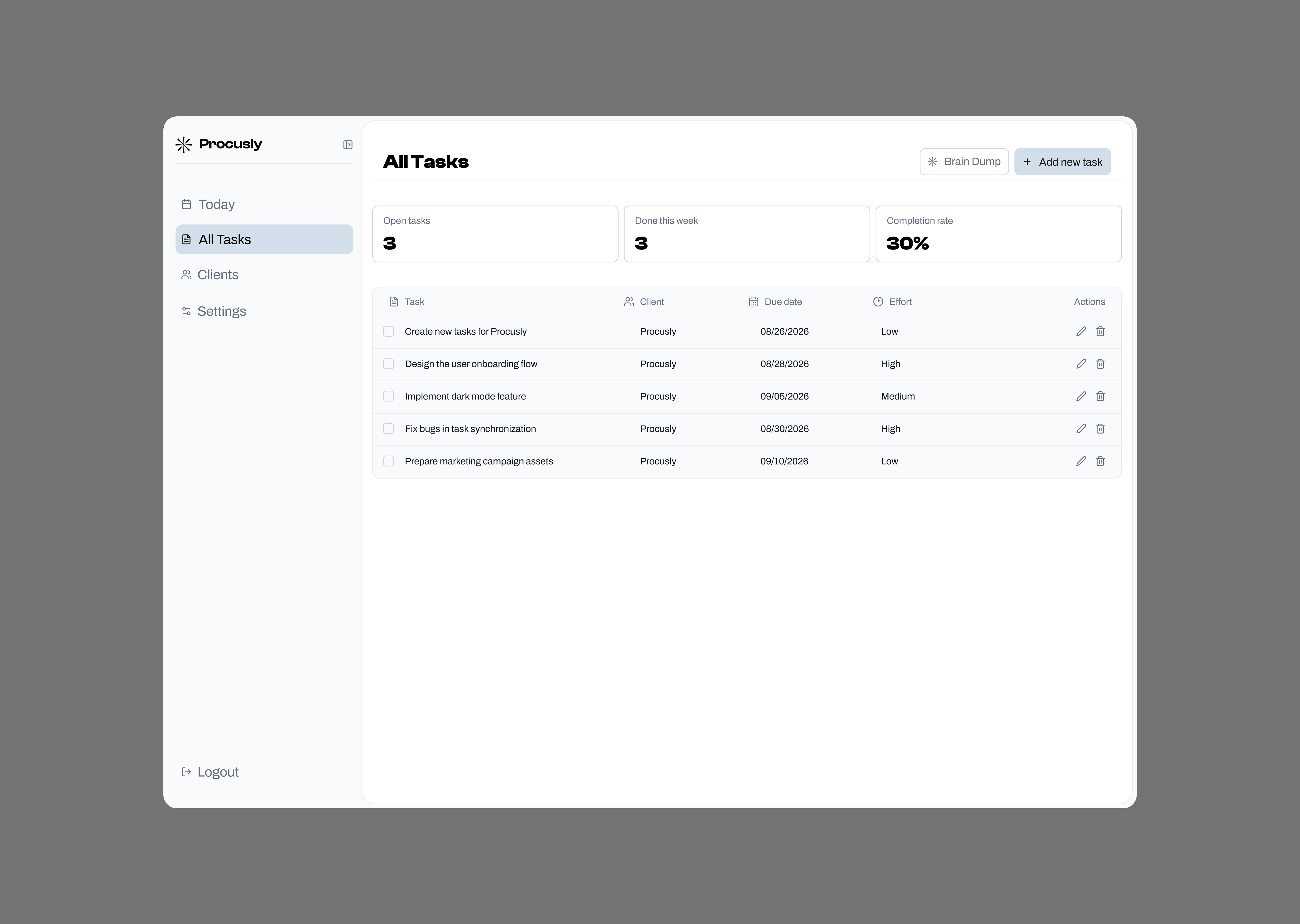
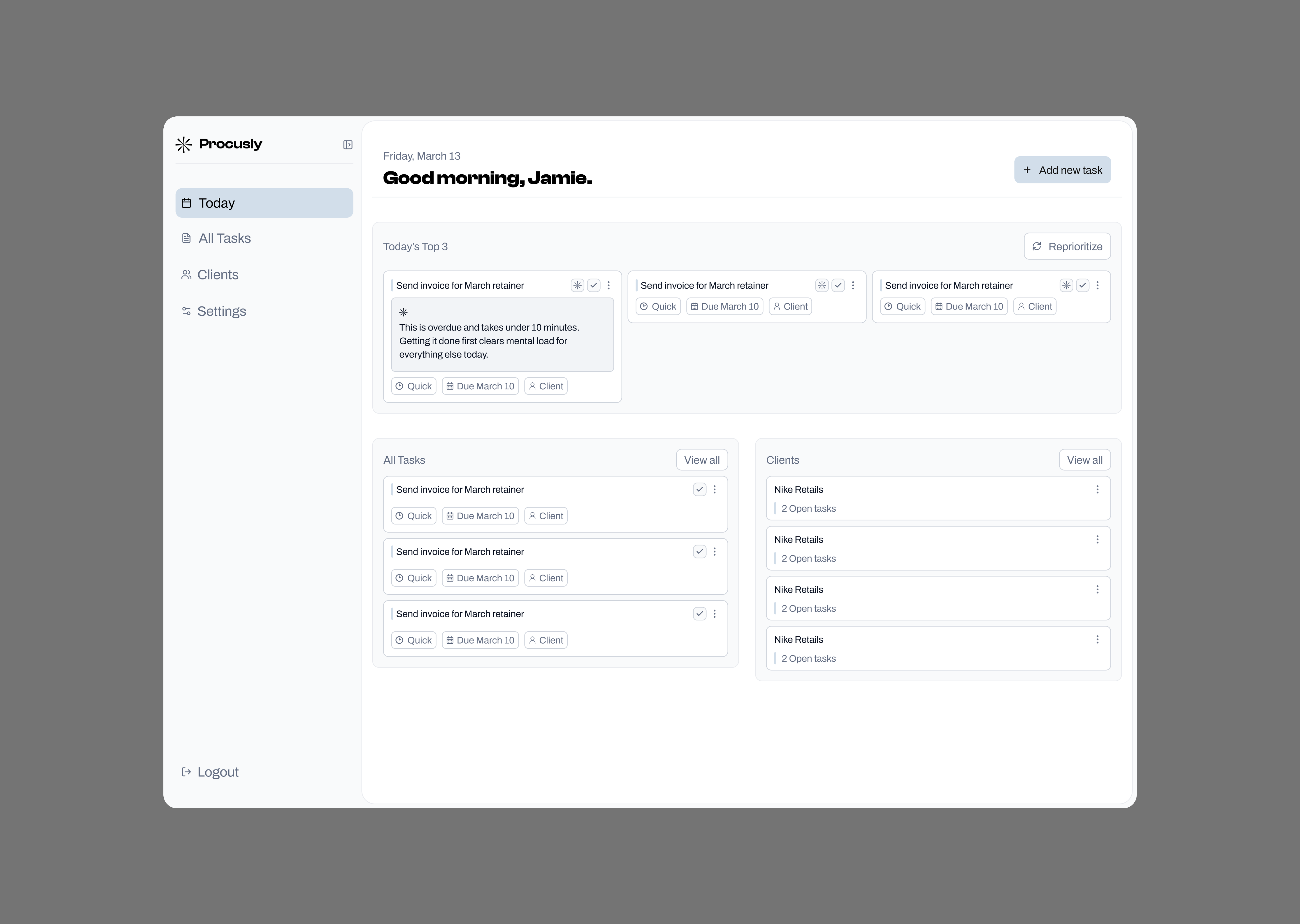
Every powerful productivity tool I studied felt like a cockpit. Feature-dense, visually complex, requiring setup before it could be used. Procusly was designed to feel like the opposite — a quiet, confident space that already has the answer waiting for you. This showed up in every micro-decision: warm off-white backgrounds instead of stark white, a single primary brown instead of a rainbow of status colours, generous whitespace between elements, no sidebar icons or navigation badges competing for attention.
"The dashboard should feel like opening a notebook someone has already marked for you — not a control panel you have to operate."
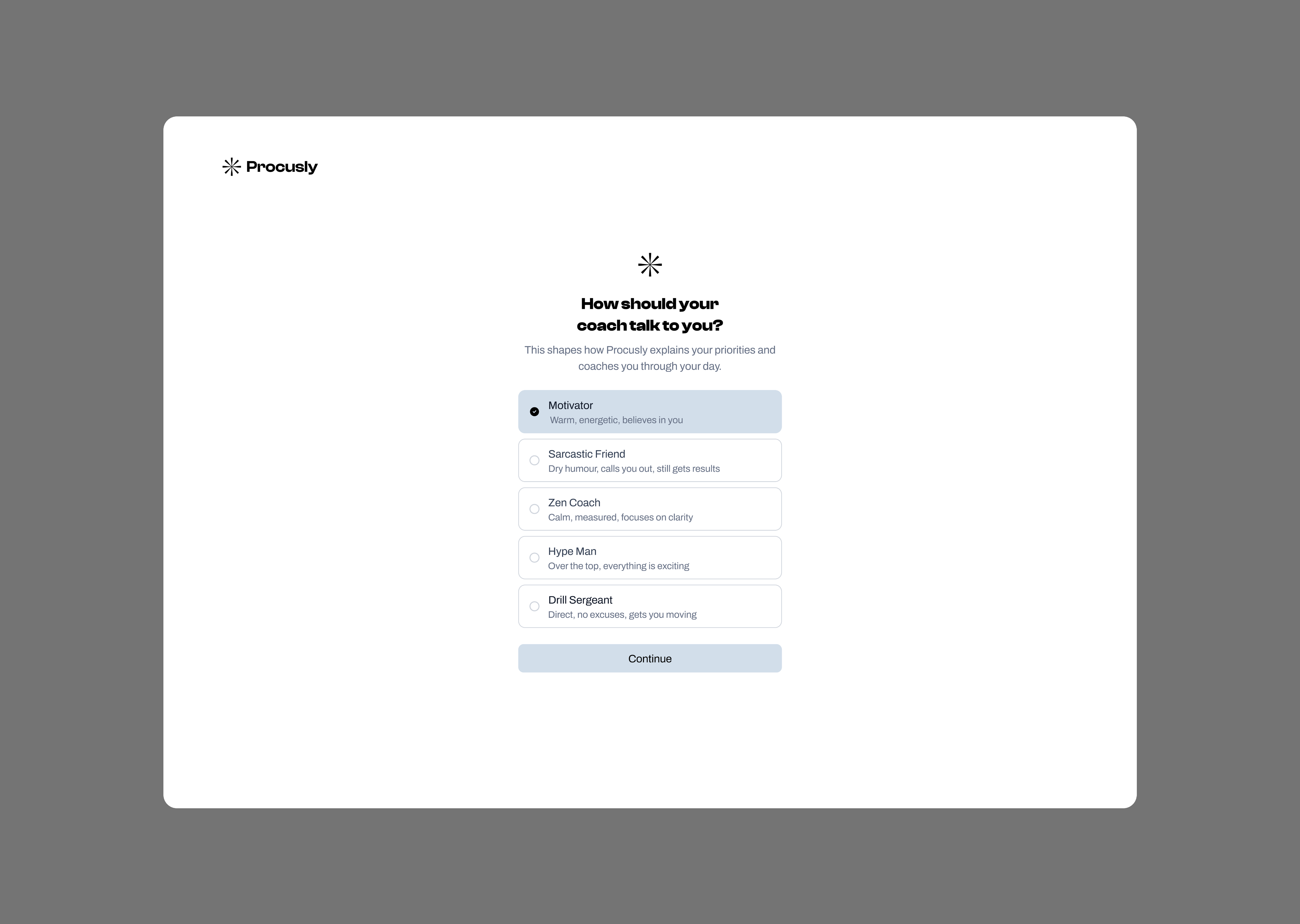
The most critical design decision in the entire product was giving the AI a personality. Not a name. Not a mascot. A voice. Five coach personalities were designed from scratch — each with a distinct tone, vocabulary, and emotional register:
- Maya the Motivator: Speaks warmly and believes in you.
- Rex the Drill Sergeant: Direct with no room for excuses.
- Finn the Sarcastic Friend: Calls you out with dry humour.
- Kai the Zen Coach: Brings measured clarity.
- Blaze the Hype Man: Over the top and relentless.
This wasn't a cosmetic feature. The personality system fundamentally changed how users experienced the AI's reasoning. A task labelled Critical by Kai sounds like a gentle invitation to address something important. The same task through Rex sounds like an order. Same data, entirely different emotional experience — and different motivation.
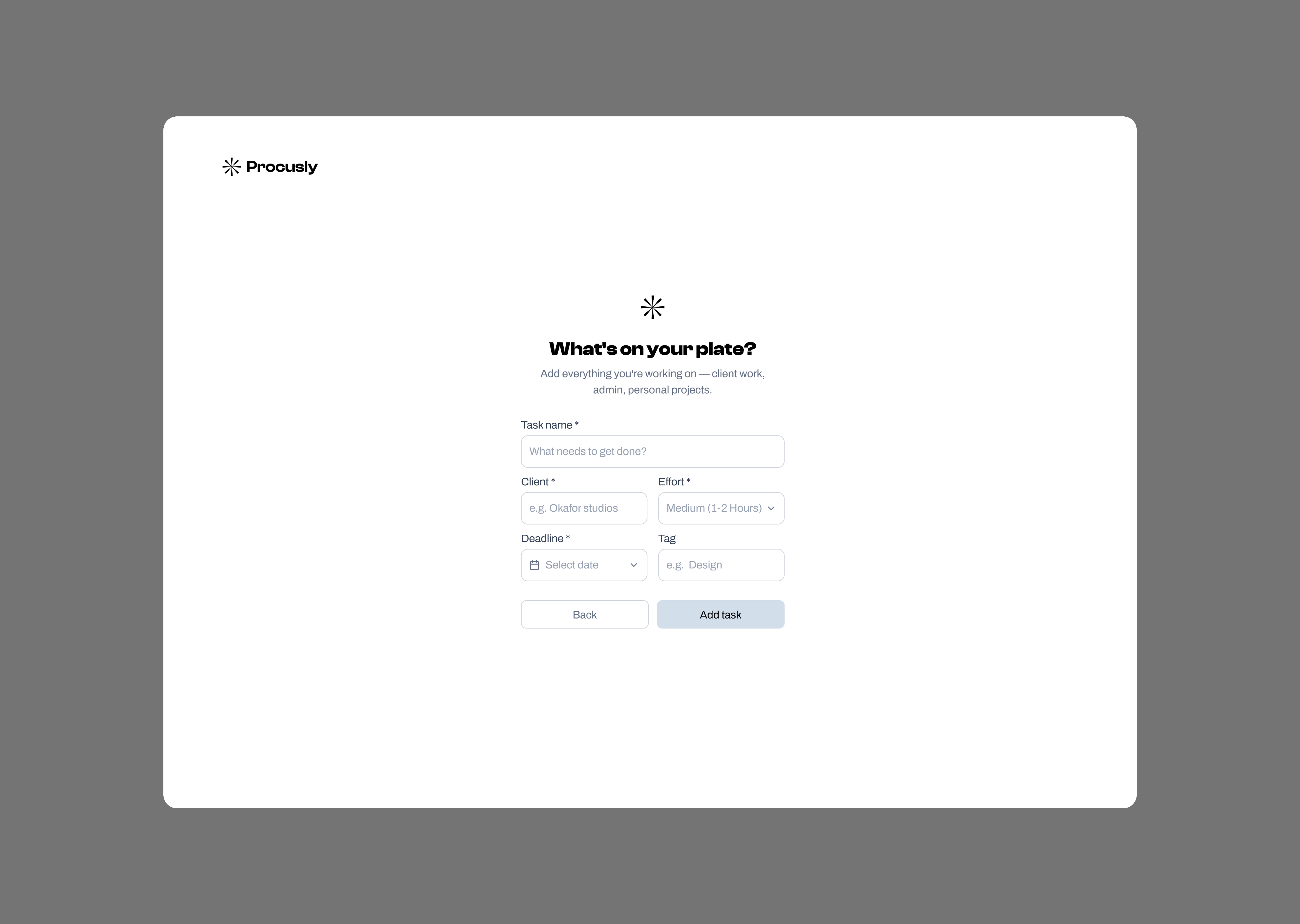
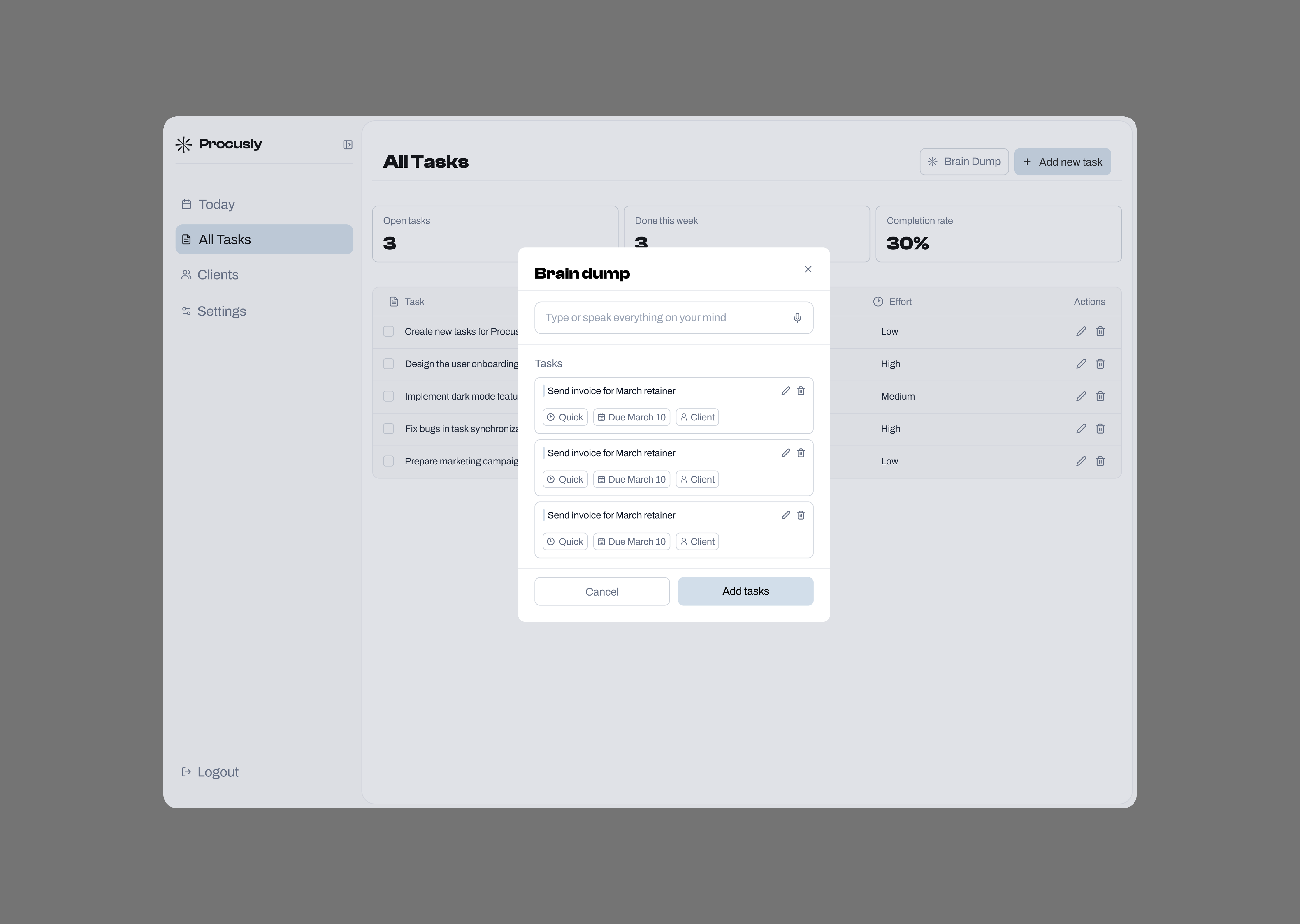
Most productivity apps try to make everything as easy as possible. Procusly made one deliberate friction choice: users must add tasks with real information — title, client, effort, deadline — before the AI can pick well. Brain Dump mode was built specifically to lower the barrier to honest task entry. Honest, specific tasks produce picks that feel like the AI actually understands your work.
The full design pass on the dashboard, clients view, and settings was deliberately deferred until all features were built and validated with real users. Applying a polished visual layer to an unvalidated feature set is a waste. Features first. Design after the structure is confirmed.
Key Decisions & Trade-offs
Claude Haiku over GPT
Chosen for its warm, conversational coaching tone that feels human. GPT-4o was technically precise but felt colder.
Supabase over Custom Backend
Removed weeks of infrastructure setup for auth, database, and real-time subscriptions.
Personality First, Preferences Second
Onboarding collects the coach personality in Step 2 to establish an immediate emotional connection before any cognitive work begins.
Dev/Prod Separation
procusly.com holds a coming soon page while dev.procusly.com handles active testing to protect brand perception.
OTP over Magic Links
Replaced magic links with a 6-digit OTP code to keep users in session without context switching to an email app.
Naming the Coaches (Maya, Rex, Finn, Kai, Blaze)
Real names created immediate parasocial connections, significantly improving daily return rates.
What I Learned
- About Building: Code isn't something to just write; it's something to direct. AI development forced total clarity on data models and state management that static wireframes often conceal.
- About Users: One testing participant completed onboarding and never returned because day-2 habit loops weren't enforced. This shifted our focus directly toward day-2 retention mechanics (digest emails, deadline nudges).
- About AI: Prompt architecture is the UX. Trust is earned over time through clear, plain-language reasoning explanations.
- About Design with Code: Designing and building forces you to address edge cases immediately rather than passing them off to an engineering handoff.
Closing Thoughts
Procusly is live, operational, and evolving. The foundation is solid, the core mechanic works, and real users are shipping work guided by AI coaching personalities they selected. "I built this because I needed it. The fact that others need it too is what makes it a business rather than a personal tool."